Corridor Comparison: Keith vs Chase
Both pilots launched from Domi and flew the same SE corridor toward the coast. Chase flew out-and-back on Feb 5. Keith flew one-way to Playa Hermosa on Mar 16. Same terrain, same thermal sources — different results.
🔵 Keith Gould
🟠 Chase
Thermal Skill — Head to Head
Turns
Consistency
Extraction
(m/s)
(m/s)
📊 Metric Breakdown
Keith centers faster and extracts more lift. Lock-in at 1.4 turns vs Chase's 2.5 — Keith finds the core faster. Extraction at 40% vs 37% — Keith captures slightly more of the available lift relative to peak.
Chase shows stronger consistency and climb rates. 97.5% consistency is elite — once he's in, he almost never hits sink. His climb rates are stronger across the board (0.81 avg vs 0.62, 2.05 peak vs 1.64). This is likely a combination of experience reading thermals and possibly wing class difference.
What this suggests: Keith is centering faster but not climbing as hard. Chase centers slower but once he's locked in, he stays in the strongest part of the core.
Altitude Profile
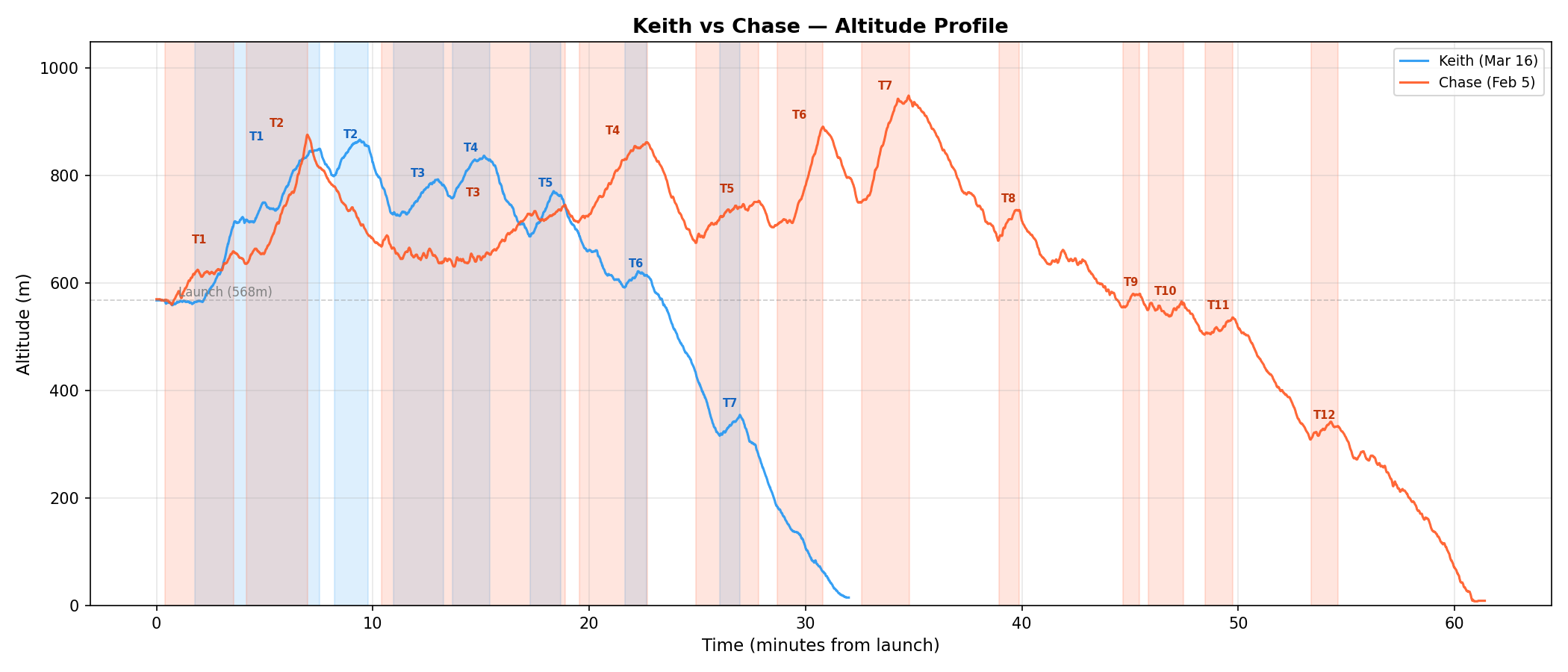
🔑 The Key Difference: Latitude 9.21
Both pilots flew the same corridor. But look at what happened south of 9.22°N:
Keith at 9.21: 555m — below launch altitude, gliding down with no usable lift.
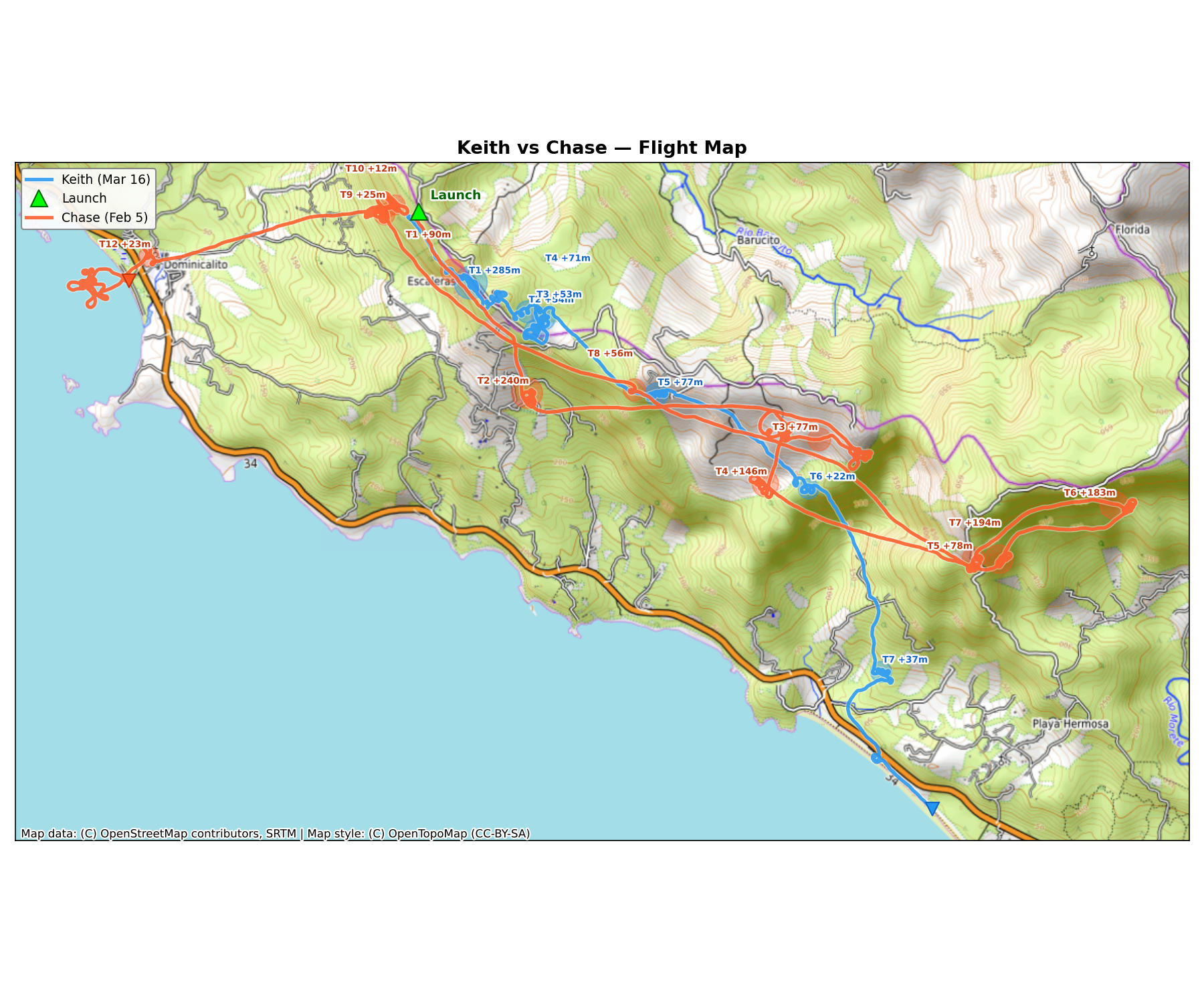
Chase at 9.21: 752m outbound, 949m on return — Chase found two strong thermals (T6: +183m to 891m, T7: +194m to 945m) in a zone east of Keith's line, near 9.21, -83.76.
These thermals are what funded Chase's return trip. Keith passed through the same latitude 82m lower and ~1km further west, and didn't connect with them. Whether this is a conditions difference (different days), a line difference, or a thermal-finding difference is worth exploring on a future flight.
Thermal Locations
| # | Pilot | Time | Location | Gain | Peak Alt |
|---|---|---|---|---|---|
| T1 | 🔵 Keith | 13:03 | 9.233, -83.813 | +285m | 850m |
| T2 | 🔵 Keith | 13:10 | 9.231, -83.809 | +54m | 855m |
| T3 | 🔵 Keith | 13:12 | 9.229, -83.808 | +53m | 783m |
| T4 | 🔵 Keith | 13:15 | 9.230, -83.807 | +71m | 830m |
| T5 | 🔵 Keith | 13:19 | 9.224, -83.798 | +77m | 764m |
| T6 | 🔵 Keith | 13:23 | 9.216, -83.785 | +22m | 615m |
| T7 | 🔵 Keith | 13:27 | 9.201, -83.779 | +37m | 354m |
| T2 | 🟠 Chase | 12:18 | 9.224, -83.809 | +240m | 876m ⭐ |
| T3 | 🟠 Chase | 12:24 | 9.220, -83.784 | +77m | 746m |
| T4 | 🟠 Chase | 12:33 | 9.216, -83.789 | +146m | 862m |
| T6 | 🟠 Chase | 12:42 | 9.214, -83.760 | +183m | 891m ⭐ |
| T7 | 🟠 Chase | 12:46 | 9.210, -83.769 | +194m | 945m ⭐ |
⭐ = thermals that exceeded Keith's max altitude. Chase's T6 and T7 are east of Keith's line — the thermal zone near 9.21, -83.76 to -83.77.
Flight Map
📋 Takeaways
The return-trip thermals are east of Keith's line. Chase found +183m and +194m thermals near 9.21, -83.76. Keith's track ran through 9.21 at -83.785 — about 2.5km further west and 200m lower. On a future "fly to the beach and back" attempt, drifting east near 9.21 to work that thermal zone could be the difference.
Keith's thermalling technique is competitive. Faster lock-in and better extraction than Chase. The gap is in consistency (91% vs 97.5%) and raw climb rates. Consistency is improving (career 81% → 91% on this flight). Climb rates may partly be conditions — Chase flew on a different day.
To make the return trip: Need to reach ~900m+ at latitude 9.21 to have enough altitude to thermal back. Chase hit 945m. Keith hit 555m at the same latitude. The 400m gap is mostly about finding those eastern thermals.